
“The quality of a teacher’s questions tells you more about their pedagogy than any lesson plan ever could.”
⏱ 4 min read · Category: Pedagogy / New Teachers
Here’s a moment most of us recognise. You’ve just delivered what felt like a cracking lesson. The kids were (mostly) engaged, you got through your content, and you asked plenty of questions along the way. But when you reflect later, you realise nearly every question you asked had a one-word answer. “What is photosynthesis?” “Who was the first Governor-General of Australia?” “What is 6 times 8?”
Sound familiar? You’re in great company — research consistently shows that the majority of classroom questions teachers ask sit at the bottom of Bloom’s taxonomy: recall and comprehension. And while there’s absolutely a place for knowledge retrieval, if that’s where the questioning stays, we’re leaving enormous learning potential on the table.
What Does the Research Say?
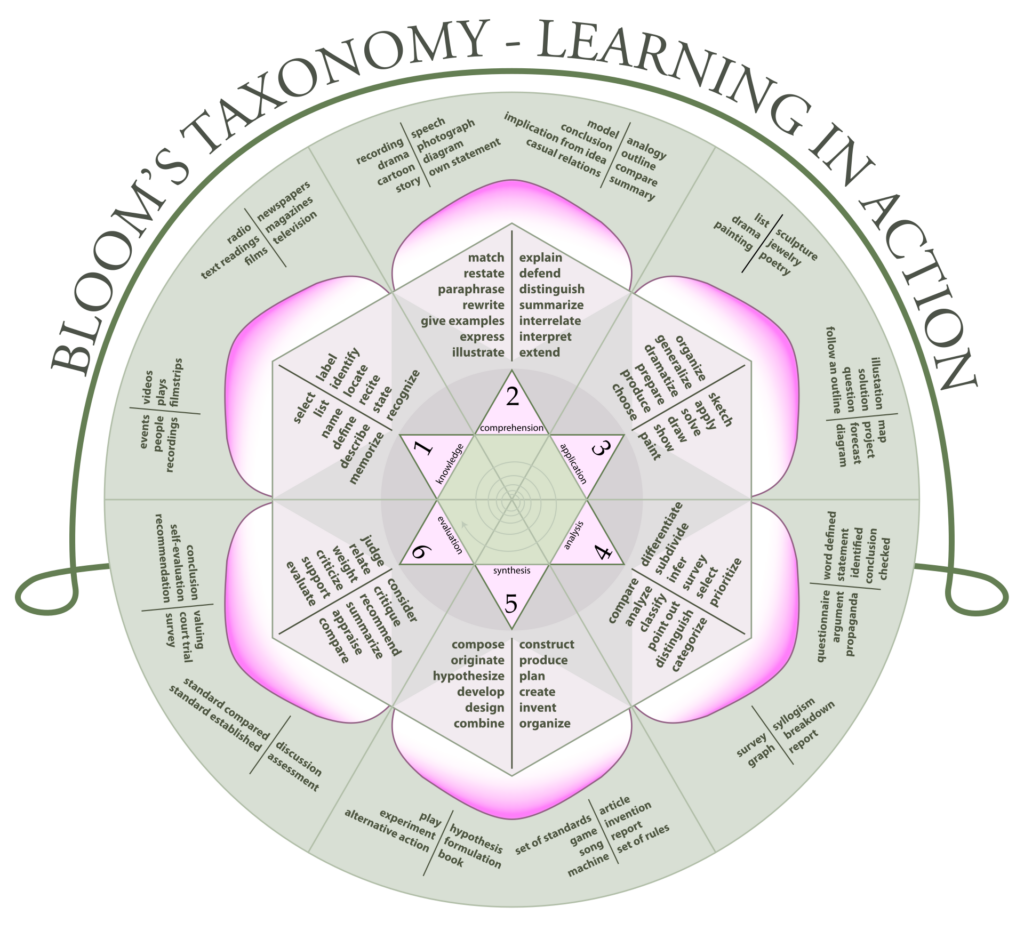
Benjamin Bloom’s taxonomy (1956), revised by Anderson and Krathwohl in 2001, remains one of the most practically useful frameworks in education. The revised model moves from Remembering at the base through Understanding, Applying, Analysing, Evaluating, to Creating at the apex. Higher-order questions push students into the top three levels — and this is where genuine critical thinking happens.
John Hattie’s landmark meta-analysis Visible Learning (2009) reinforced the power of teacher-student dialogue, finding that classroom discussion and questioning strategies have a significant effect on student achievement. More recently, Fisher and Frey (2014) describe “purposeful questioning” as a cornerstone of their gradual release of responsibility model — where the teacher’s role shifts from information-giver to intellectual provocateur.
“The questions we ask are the thinking we demand. Low questions = low thinking. If we want children to think critically, we need to ask critically.” — Adapted from Bloom et al.
The HOTS/LOTS Shortcut
A quick mental shorthand that works brilliantly in the classroom: LOTS (Lower Order Thinking Skills) vs HOTS (Higher Order Thinking Skills). LOTS questions have predictable, often single-word answers. HOTS questions require students to think, justify, compare, or create. Here’s the key difference in practice:
🔁 Flip Your Questions: LOTS → HOTS
- LOTS: “What is an ecosystem?” → HOTS: “If a keystone species disappeared from an ecosystem, what do you predict would happen — and why?”
- LOTS: “When was Federation?” → HOTS: “Was Australian Federation inevitable? What evidence supports your view?”
- LOTS: “What is a simile?” → HOTS: “How does the author’s use of simile in this passage change how you feel about the character?”
- LOTS: “What are the states of matter?” → HOTS: “Design an experiment that would demonstrate all three states of matter to a Year 3 class.”
3 Practical Strategies to Try This Week
1. The Parking Lot Question. Write a big, juicy HOTS question on the board at the start of the lesson — even before you’ve taught the content. Tell the students this is where you’re heading. It primes their brains, creates cognitive dissonance, and builds anticipation. Revisit it at the end.
2. Question Stems on a Lanyard Card. Create a small reference card of question stems aligned to each level of Bloom’s. Laminate it and keep it with you. When you feel yourself defaulting to LOTS questions, glance at the card. Stems like “How would you justify…”, “What is the relationship between…”, “How could you redesign…” are gold.
3. Wait Time. This is perhaps the single most powerful — and most underused — questioning technique. After asking a HOTS question, wait at least 5–7 seconds before accepting responses. Research by Mary Budd Rowe (1986) showed that extending wait time increased the length and quality of student responses dramatically. Silence is not failure — it’s thinking.
https://commons.wikimedia.org/wiki/File:Blooms_rose.svg

A Note for Australian Teachers
The Australian Curriculum’s General Capabilities — particularly Critical and Creative Thinking — explicitly require students to pose questions, consider alternatives, and evaluate evidence. Embedding HOTS questioning into your daily practice isn’t an add-on; it’s directly aligned with what ACARA expects. It also prepares students for NAPLAN reading and writing tasks that increasingly demand inferential and analytical thinking rather than simple recall.
💬 Your Turn! What’s your favourite HOTS question stem? Drop it in the comments below — let’s build a shared bank of great questions for Australian classrooms!
References
Anderson, L. W., & Krathwohl, D. R. (Eds.). (2001). A taxonomy for learning, teaching, and assessing: A revision of Bloom’s educational objectives. Addison Wesley Longman.
Australian Curriculum, Assessment and Reporting Authority (ACARA). (2023). Australian Curriculum v9.0: Critical and creative thinking. https://v9.australiancurriculum.edu.au
Bloom, B. S., Engelhart, M. D., Furst, E. J., Hill, W. H., & Krathwohl, D. R. (1956). Taxonomy of educational objectives: The classification of educational goals. Handbook I: Cognitive domain. David McKay.
Fisher, D., & Frey, N. (2014). Better learning through structured teaching: A framework for the gradual release of responsibility (2nd ed.). ASCD.
Hattie, J. (2009). Visible learning: A synthesis of over 800 meta-analyses relating to achievement. Routledge.
Rowe, M. B. (1986). Wait time: Slowing down may be a way of speeding up. Journal of Teacher Education, 37(1), 43–50. https://doi.org/10.1177/002248718603700110