5 Powerful Moves That Will Actually Make Students Struggle

Week 15 · Pedagogy · Task Design

5 Task Design Moves That Actually Stretch Every Student

Productive struggle isn’t what happens when a task is too hard. It’s what happens when you’ve designed it just right.
⏱ 6 min read · By Matt Faulkner · Pedagogy / New Teachers

There is a particular kind of classroom frustration that has nothing to do with behaviour. It is the lesson where students race through the task, and you realise about twelve minutes in that it asked nothing of them. Or the opposite: where you pitched it harder and now three hands are up, six students are staring at the ceiling, and two have quietly written their name and stopped.

Both of those outcomes have the same root cause. The task was not designed with stretch in mind. It was designed with content in mind — and there is a difference.

Last week, we looked at how backward design changes what you plan for. This post takes the next step. Once you know where students need to get to, the question becomes: how do you design the task that gets them there — one that genuinely challenges without tipping into frustration? The answer has a name in the research literature: productive struggle. And it can be deliberately built in.


What “Just Beyond Comfortable” Actually Means

Lev Vygotsky described the zone of proximal development (ZPD) as the space between what a learner can do independently and what they can do with support. Tasks that sit below the ZPD require no new thinking. Tasks that sit too far above it produce confusion and disengagement. Tasks that sit right at the edge of the ZPD — just beyond what a student can currently do alone — are where genuine learning occurs.

John Sweller’s cognitive load theory adds important precision here. Working memory is limited. When a task overloads it — too many new elements at once, too much unfamiliar vocabulary, too many simultaneous steps — students cannot process the content, let alone learn from it. In other words, difficulty alone is not the goal. Productive difficulty is. The task needs to be complex enough to require real thinking, but structured enough that thinking is actually possible.

For teachers, that distinction is everything. A task is not automatically rigorous because it is hard. It is rigorous when it demands higher-order thinking within a structure students can manage. As a result, designing for productive struggle is less about making tasks harder and more about making them smarter.


The Mindset Piece: Designing for Effort, Not Just Difficulty

Carol Dweck’s research on growth mindset is relevant here — but not in the way it is usually applied. It is not enough to tell students that struggle is good for them. If the task design sends the opposite message — if there is only one right answer, if being wrong feels like failure, if speed is implicitly rewarded — then the growth mindset poster on the wall is just decoration.

Dweck’s central finding is that students who believe intelligence is fixed avoid challenge to protect their self-image. By contrast, students who believe ability grows through effort seek out challenge. The task itself can reinforce either belief. A task with one quick answer rewards speed and confidence. A task that requires iteration, justification, and revision sends the message that effort is the point.

That said, this is not about lowering the stakes or removing rigour. It is about designing tasks where being stuck is a legitimate part of the process — and where the structure supports students to push through, rather than wait for the teacher to rescue them.

There is a timely corollary here for AI use in classrooms. Cognitive scientist Paul Kirschner draws a useful distinction between cognitive offloading and cognitive outsourcing. Offloading — writing notes, drawing a diagram, working through steps on paper — frees up working memory while keeping the student as the thinker. Outsourcing — asking AI to explain, summarise, or produce — transfers the thinking itself to an external agent. The student receives a finished product. Nothing is encoded in long-term memory. For teachers designing tasks with productive struggle in mind, the question is worth asking: does the way students are using AI protect generation, or remove it entirely?


5 Design Moves That Build Productive Struggle In

These moves can be applied individually or in combination. They work across year levels and learning areas. Even one move applied consistently will shift what students experience in your classroom.

🎯 5 Task Design Moves for Productive Struggle
  • Move 1 — Open the entry point. Design tasks with a low floor and a high ceiling. Every student can begin; not every student will reach the same endpoint. This removes the paralysis of “I don’t know where to start” while keeping stretch available for those who are ready for it. Jo Boaler’s work on low-floor/high-ceiling tasks in mathematics is the clearest articulation of this principle in practice — and her YouCubed site has free task banks worth bookmarking.
  • Move 2 — Withhold the scaffold before the answer. Give students the problem before you give them the method. Even five minutes of initial thinking — before any explicit teaching — activates prior knowledge, surfaces misconceptions, and means the instruction that follows has somewhere to land. This is not about leaving students stranded. It is about priming the brain to receive new learning. There is a memory research term for what happens here: the Generation Effect. When students generate an answer — retrieve a word, attempt a problem, construct an explanation — they remember it significantly better than when the same information is simply presented to them. The act of production is itself the act of learning. Jamie Clark’s DistillED newsletter on the Generation Effect is worth reading alongside this post — it is one of the clearest explanations of the research and its classroom implications available right now.
  • Move 3 — Limit the information given upfront. Real-world problems rarely arrive with all the relevant information pre-sorted. Give students a question and some — not all — of the information they need. Require them to identify what’s missing or what they’d need to know. That act of identifying gaps is itself higher-order thinking.
  • Move 4 — Require justification, not just answers. “What is the answer?” asks for recall. “How do you know?” asks for thinking. Build justification into the task structure — not as an add-on, but as the core requirement. A student who can get the right answer but cannot explain it has not yet learned what you think they’ve learned.
  • Move 5 — Build in a “stuck” protocol. Before students begin, name what to do when they get stuck. Three specific options: re-read the task, try a different starting point, or discuss with a partner using a sentence starter (“I think the problem is asking me to…”). This removes the habit of raising a hand the moment something feels difficult — and it signals that being stuck is expected, not a sign of failure.

What This Looks Like in HASS: Year 5 Source Analysis

A standard source analysis task gives students a primary source and asks them to identify the author, date, and one key message. That is a recall task. It sits well below the ZPD for most Year 5 students who have been doing this since Year 3.

A productive struggle version applies Moves 1, 3, and 4. Students receive two short sources on colonial settlement — a settler’s diary entry and an account from an Aboriginal perspective — with no guiding questions. The task is simply: what story are these two sources telling, and where do they disagree? From there, students must write one claim supported by evidence from both sources.

The open entry point (Move 1) means every student can begin with an observation. Limiting the guiding questions (Move 3) means students must decide what matters. Requiring a supported claim (Move 4) means the answer is not retrievable without genuine analysis. The teacher’s role shifts from answer-giver to question-asker — circulating and probing with higher-order questions that push thinking further rather than narrowing it toward a predetermined response.

For more on structuring formative checks around this kind of task, the post on formative assessment strategies covers exit ticket design in detail.


What This Looks Like in Maths: Year 3 Multiplication

A standard multiplication task: Solve 3 × 4. Solve 5 × 6. Solve 7 × 8. Students either know these or they don’t. There is no thinking available beyond retrieval — and no entry point for students who aren’t yet fluent.

A productive struggle version uses Move 1 and Move 2. The teacher displays 24 counters on the interactive whiteboard and asks: how many different ways can you arrange these into equal rows? No method has been taught yet. Students work with their own counters, recording each arrangement. From there, the class shares findings — and the teacher introduces the array and the number sentence as the language for what students already discovered.

The low floor means students working at different points of readiness can all begin. The high ceiling means a student who finds three arrangements quickly is asked: how do you know you’ve found them all? That follow-up question — requiring justification and systematic thinking — is where the stretch lives. In practice, it produces more mathematical reasoning than a worksheet of 20 isolated facts ever will.

Beyond that, notice what the task design does to the explicit teaching that follows. Because students have already struggled with the concept, the instruction has a problem to solve. It lands differently than instruction delivered cold.


Where the Gradual Release Fits

Fisher and Frey’s Gradual Release of Responsibility model — I do, We do, You do — is one of the most widely used frameworks in Australian primary schools. It is also frequently misapplied in ways that accidentally prevent productive struggle.

The problem arises when the “I do” phase is so thorough that the “You do” phase requires nothing beyond imitation. Students are not struggling — they are copying. The GRR is designed to scaffold students into independence, not to eliminate the experience of not-yet-knowing.

Used well, the GRR creates the conditions for productive struggle at the “You do” stage by deliberately withdrawing support at the right moment. The key is that the “We do” phase builds enough shared understanding that students can tolerate uncertainty — not so much that the independent task becomes a rehearsal of what they’ve already watched you do.

That calibration — knowing when to hold the scaffold and when to pull it back — is one of the most important professional judgements in teaching. Even so, it is a judgement that gets easier with practice. And it starts with task design that has stretch built in from the beginning.

Design the task for the thinking you want, not just the answer you need. Students rise to what the task demands of them — and rarely higher.

💬 Over to You — Which of the five moves are you already using, and which one are you going to try first? Or if you’ve got a task that created genuinely productive struggle in your classroom, share it below. The best ideas on this site always come from teachers who’ve already done the hard yards.

References

Bertsch, S., Pesta, B. J., Wiscott, R., & McDaniel, M. A. (2007). The generation effect: A meta-analytic review. Memory & Cognition, 35(2), 201–210. https://doi.org/10.3758/BF03193441

Bjork, E. L., & Bjork, R. A. (2011). Making things hard on yourself, but in a good way: Creating desirable difficulties to enhance learning. In M. A. Gernsbacher, R. W. Pew, L. M. Hough, & J. R. Pomerantz (Eds.), Psychology and the real world: Essays illustrating fundamental contributions to society (pp. 56–64). Worth Publishers.

Boaler, J. (2016). Mathematical mindsets: Unleashing students’ potential through creative math, inspiring messages and innovative teaching. Jossey-Bass.

Dweck, C. S. (2006). Mindset: The new psychology of success. Random House.

Fisher, D., & Frey, N. (2014). Better learning through structured teaching: A framework for the gradual release of responsibility (2nd ed.). ASCD.

Kirschner, P. A. (2026). Offloading? No outsourcing! Retrieved from https://paulkirschner.com

Slamecka, N. J., & Graf, P. (1978). The generation effect: Delineation of a phenomenon. Journal of Experimental Psychology: Human Learning and Memory, 4(6), 592–604. https://doi.org/10.1037/0278-7393.4.6.592

Sweller, J. (1988). Cognitive load during problem solving: Effects on learning. Cognitive Science, 12(2), 257–285. https://doi.org/10.1207/s15516709cog1202_4

Vygotsky, L. S. (1978). Mind in society: The development of higher psychological processes. Harvard University Press.

How Smart Teachers Plan Backwards — and Get Better Results

Here is a question worth sitting with: when you plan a lesson, what do you plan first? If the answer is “the activity” — the game, the worksheet, the group task — you are in good company. Most new teachers start there. In practice, that instinct is also the source of one of the most common planning problems in Australian classrooms: lessons that are busy but not particularly purposeful.

The shift that separates competent planning from genuinely effective planning is deceptively simple. Expert teachers start at the end. They ask: what do students need to know or be able to do by the close of this lesson? From there, everything else flows backwards from that answer — the activities, the questions, the formative checks.

That approach has a name: backward design. Put simply, it means designing for learning rather than for activity. This post explains how it works, why the research supports it, and what it looks like in two real Australian classrooms — one in HASS, one in Maths.


Why “Covering the Content” Isn’t Planning

Grant Wiggins and Jay McTighe introduced backward design in Understanding by Design (2005) — and it remains one of the most cited frameworks in curriculum planning. Their core argument is straightforward: if you design a lesson around an activity, the activity becomes the goal. If you design it around a learning outcome, the activity becomes the vehicle.

The difference matters more than it sounds. An activity-first lesson might be engaging and enjoyed by students. By contrast, a learning-first lesson does all of that and moves students measurably closer to a specific understanding. One fills time well. The other changes what students can do.

John Hattie’s research reinforces this. In Visible Learning for Teachers (2012), he identifies clear learning intentions and success criteria as among the highest-leverage moves a teacher can make — with an effect size of 0.75 on student achievement. That said, intentions only work when they are genuinely specific. “Students will learn about fractions” is not a learning intention. “Students will be able to add fractions with the same denominator and explain why the denominator stays the same” is.

The Three-Stage Planning Framework

Wiggins and McTighe describe backward design in three stages. In the Australian context, each maps directly onto the AITSL Professional Standards that preservice and early-career teachers are assessed against. For that reason, understanding the framework is not just good pedagogy — it is also good professional preparation.

🪜 Backward Design: Three Stages
  • Stage 1 — Identify desired results. What should students know, understand, and be able to do? This comes directly from the Australian Curriculum content descriptor and achievement standard for your year level. This is where AITSL Standard 2 (Know the content and how to teach it) does its work — you cannot write a learning intention for content you don’t understand deeply yourself.
  • Stage 2 — Determine acceptable evidence. How will you know students have learned it? This is your assessment — not just the end-of-unit test, but the formative check you build into the lesson itself. Exit tickets, questioning, observation, mini whiteboards. AITSL Standard 5 (Assess, provide feedback and report) lives here.
  • Stage 3 — Plan learning experiences. Only now do you choose activities — the ones that most efficiently move students from where they are to where Stage 1 says they need to be. This is AITSL Standard 3 (Plan for and implement effective teaching and learning) in action.

Notice the order. Assessment comes before activities. For most new teachers, that sequence feels backwards — even counterintuitive. In practice, it is the sequence that makes every other planning decision easier. Each activity can then be evaluated against one clear question: does this move students toward the learning intention, or does it just fill time nicely?


Stage 1 in Practice: Writing a Learning Intention That Works

A learning intention describes what students will learn — not what they will do. “Students will complete a fact file about ancient Egypt” is a task description. By contrast, “Students will identify two ways ancient Egyptians adapted their way of life to the Nile River” is a learning intention. The distinction is worth practising until it becomes automatic.

Hattie suggests sharing the learning intention with students at the start of the lesson — not as a compliance exercise, but because students who know where they are going are better placed to monitor their own progress. That self-monitoring is itself a high-leverage learning behaviour. For this reason, the learning intention pairs naturally with a success criterion: a student-facing description of what meeting the intention looks like in practice. The Australian Curriculum v9.0 achievement standards are the most reliable anchor for writing success criteria at the right level.

✏️ Learning Intention vs Success Criterion — The Difference
  • Learning intention: “We are learning to identify how the features of a place influence the way people live.” (The what of learning — teacher-language, curriculum-anchored.)
  • Success criterion: “I can name two features of the Nile River and explain how each one shaped life for ancient Egyptians.” (The how will I know — student-language, observable, specific.)
  • Not this: “We are learning about ancient Egypt.” (Too broad — students cannot self-assess against it, and neither can you.)

AITSL Standard 1 (Know students and how they learn) shapes how you write these. A success criterion pitched at the wrong level — too abstract for Year 3, too simple for Year 6 — will not function as a genuine reference point for students. In other words, knowing your cohort is not separate from writing good intentions. It is part of the same act.


Worked Example 1: Year 5 HASS

The following example applies backward design to a Year 5 HASS lesson on colonial Australia, anchored to the Australian Curriculum.

📋 Backward Design in Action — Year 5 HASS
  • Curriculum anchor: AC9HS5K03 — The impact of colonial settlement on the lives of Aboriginal and Torres Strait Islander Peoples.
  • Stage 1 — Learning intention: “We are learning to explain how colonial settlement affected the lives of Aboriginal Peoples, using specific evidence.”
  • Success criterion: “I can describe at least two impacts of colonial settlement on Aboriginal Peoples and support each with a piece of evidence from a source.”
  • Stage 2 — Formative evidence: An exit ticket — students write two sentence starters: “One impact was… because the evidence shows…” and “Another impact was… For example…” This is collected before students leave and informs the next lesson’s starting point. For more on making exit tickets work, see our post on formative assessment strategies.
  • Stage 3 — Learning activities: (a) Paired analysis of two short primary sources — a settler diary entry and an account from an Aboriginal perspective. (b) Structured discussion: what do these sources agree on? What do they show differently? (c) Individual written response using the exit ticket stems. The Venn diagram activity — which we’ve discussed before as an alternative to the overused KWL chart — works well at step (b) to surface the contrast between sources.
  • AITSL connection: Standard 1.4 (Strategies for teaching Aboriginal and Torres Strait Islander students) and Standard 2.4 (Understand and respect Aboriginal and Torres Strait Islander people) are both directly relevant here. Source selection and discussion framing must be handled with cultural care and, where possible, informed by community consultation.

Worked Example 2: Year 3 Maths

The same framework applies equally to Maths — where the temptation to jump straight to a worksheet or manipulative activity is especially strong. Even so, the three-stage sequence holds. Start with what students need to understand; build the assessment check; then choose activities that close the gap.

📋 Backward Design in Action — Year 3 Maths
  • Curriculum anchor: AC9M3N04 — Multiply and divide using a range of mental and informal written strategies.
  • Stage 1 — Learning intention: “We are learning to use an array to show how multiplication works and explain what the rows and columns represent.”
  • Success criterion: “I can draw an array for a multiplication fact, label the rows and columns, and write the matching number sentence.”
  • Stage 2 — Formative evidence: Mini whiteboard check — teacher calls a multiplication fact (e.g. 3 × 4), students draw the array and hold it up simultaneously. Teacher scans for: correct dimensions, correct orientation, students who have drawn repeated addition rather than an array. That pattern in the errors pinpoints exactly where re-teaching is needed. See our post on reading the room mid-lesson for more on using student responses as real-time data.
  • Stage 3 — Learning activities: (a) Hook: teacher places 12 counters on a document camera and asks — “how many ways can I arrange these into equal rows?” Students explore with their own counters. (b) Explicit teaching: name the array, define rows and columns, connect to the number sentence. (c) Guided practice: three teacher-led examples with student input. (d) Independent practice: students draw and label three arrays of their choice, then write the matching number sentence. (e) Mini whiteboard exit check as described above.
  • AITSL connection: Standard 2.1 (Content and teaching strategies of the teaching area) — understanding why arrays work (not just how to draw them) is essential before teaching this lesson. Standard 3.3 (Use teaching strategies) — the move from concrete (counters) to representational (drawn array) to abstract (number sentence) is the CRA sequence, and it should be deliberate, not accidental.


The Teaching-Learning Cycle: Beyond a Single Lesson

Backward design works for a single lesson. It works even better when it organises a whole unit. The teaching-learning cycle used across Australian curriculum areas — building the field, deconstruction, joint construction, independent construction — is itself a backward-designed structure. You begin with the end text or performance in mind and work back through the scaffolding students need to get there.

For new teachers, the most practical application is this: before you plan any lesson in a unit, write the end-of-unit assessment task first. Not after you’ve taught everything — before. That task becomes your compass. Consequently, every lesson can be evaluated against one question: does this move students closer to being able to do that?

Beyond that, this approach connects directly to what we’ve explored in our posts on designing a performance of worth and feedback that feeds forward — both of which assume a clear destination that students are working toward. Without a backward-designed starting point, those strategies lose their anchor.

A Note on Using AI in This Process

If you are using AI to support your planning — and there are good reasons to — backward design gives you a much stronger prompt structure. Instead of asking AI to “write a lesson plan on fractions,” give it your learning intention, your success criterion, and your formative check. From there, ask it to suggest activities that bridge the gap. That sequence produces something genuinely useful. By contrast, starting with “write me a lesson” produces something generic.

In other words, the quality of your AI output is a direct reflection of how clearly you have done Stage 1 yourself first. The framework does not become less relevant when AI is involved. If anything, it becomes more important.


The One-Page Planning Habit

For preservice teachers on prac, and for first-year teachers building confidence, a full backward-design unit plan for every lesson is not realistic. That said, the thinking behind backward design can be applied in under five minutes per lesson with a simple habit. Before you open any planning document, write three things on a sticky note.

🎯 The Three-Question Planning Check
  • What will students be able to do by the end that they couldn’t do at the start? (Your learning intention — one specific, observable thing.)
  • How will I know if they’ve got there? (Your formative check — exit ticket, whiteboard, observation, question.)
  • What is the most direct path from here to there? (Your activity sequence — chosen because it serves the intention, not because it fills the time.)

Those three questions, answered honestly before you start planning the rest, will improve your lessons more reliably than any template, resource pack, or planning app. They are the essence of what AITSL Standard 3 asks of you. Put simply, they are the difference between a lesson that covers content and a lesson that builds learning.

“Don’t ask ‘what will I teach today?’ Ask ‘what will students be able to do at the end that they couldn’t do at the start?’ The answer to the second question is your lesson.” — TeacherTalk

💬 Your Turn! Do you plan backwards from the learning intention — or do you start with the activity and work forward? And if you’ve made the switch to backward design, what changed for you? Share below — your experience is exactly what another new teacher needs to read this week.

References

Australian Curriculum, Assessment and Reporting Authority (ACARA). (2023). Australian Curriculum v9.0. https://v9.australiancurriculum.edu.au

Australian Institute for Teaching and School Leadership (AITSL). (2018). Australian Professional Standards for Teachers (Standards 1, 2, 3 & 5). https://www.aitsl.edu.au/teach/standards

Hattie, J. (2012). Visible learning for teachers: Maximising impact on learning. Routledge.

Hattie, J. (2009). Visible learning: A synthesis of over 800 meta-analyses relating to achievement. Routledge.

Wiggins, G., & McTighe, J. (2005). Understanding by design (2nd ed.). ASCD.

From Efficient to Transformative: AI, SAMR and TPACK

Week 13 · Pedagogy · Teaching with Technology

From Efficient to Transformative: AI, SAMR and TPACK

“The question is not how can I use AI? — it is how can AI help me create a transformative, student-centred learning experience?“
⏱ 5 min read · By Matt Faulkner · Pedagogy / Teaching with Technology

Walk into any staffroom right now and AI is in the conversation. Some teachers are experimenting enthusiastically, others are cautious, and most are quietly trying to work out how to respond without losing what makes their teaching meaningful.

In a recent Faculty Focus article — Humanizing Generative AI: Three Ways to Keep Students at the Center of Your Classroom — Dr Richard Violanti names a pattern that should sit at the heart of every AI-in-education conversation we are having this year. Teachers are using generative AI to draft emails, build slides, summarise readings and generate quizzes. All useful. All versions of what we already did. As Violanti puts it, the technology “enhances the product … but leaves the process of learning for the students unchanged.”

That diagnosis deserves our attention. If our ambition stops at efficiency, we will have adopted the most powerful learning technology in a generation and used it to make a slightly faster worksheet.

If our ambition stops at efficiency, we will have adopted the most powerful learning technology in a generation and used it to make a slightly faster worksheet.

This post is a follow-up to Violanti’s piece. The aim here is to take his core argument — that AI’s real promise is pedagogical, not administrative — and sit it alongside two of the most widely used frameworks in educational technology: the SAMR model (Puentedura, 2006) and the TPACK framework (Koehler & Mishra, 2009). Together, they give us a sharper way to see when AI is genuinely transforming learning, and when it is quietly substituting for what was already there.


The efficiency trap, named

Violanti’s observation is not new, but it is important. Decades of educational technology research — from Larry Cuban onwards — show that most classroom innovations end up sustaining existing practice rather than transforming it. Interactive whiteboards replaced chalkboards. PDFs replaced photocopies. Learning management systems replaced filing cabinets. Each was a genuine workflow improvement. None, on its own, changed what learning felt like for students.

Generative AI is arriving with the same gravitational pull. The path of least resistance is to wire it into what we are already doing: a faster quiz generator, a tidier email reply, a cleaner slide. These uses are not bad — they give time back. But if that is where we stop, AI becomes another tool that makes the teacher’s life marginally easier without making the student’s learning meaningfully different.

The question Violanti poses is the right one, and it links directly to the kind of intentional planning we have talked about in earlier posts on planning with purpose: not how can I use AI?, but how can AI help me create a transformative, student-centred learning experience?


SAMR: a mirror for how we are actually using AI

Ruben Puentedura’s SAMR model offers four levels of technology integration: Substitution, Augmentation, Modification and Redefinition. The lower two levels enhance existing tasks. The upper two transform them — they make possible learning experiences that simply could not exist without the technology.

Mapped onto generative AI, the levels become uncomfortably clear.

🪜 SAMR applied to generative AI
  • Substitution — AI writes the quiz you used to write yourself. Same quiz, same pedagogy, faster delivery.
  • Augmentation — AI writes a better quiz: adaptive difficulty, auto-generated distractors, instant feedback. Still a quiz.
  • Modification — A reading becomes a conversation. Students use an AI tutor to interrogate a text, surface their own misconceptions, and bring questions to class. The task is genuinely redesigned.
  • Redefinition — A task that could not exist before. A history student conducts a simulated interview with a historical figure and has to defend, with evidence, where the AI’s responses sit in the record and where they drift into plausible-sounding fiction.

None of this requires teachers to become SAMR theorists. The value of the model is its reflective prompt, which Violanti phrases neatly: is technology making learning different, or just more efficient? If the answer is “just more efficient,” we are at the bottom of the ladder. That is a reasonable place to start. It is not a reasonable place to stay.

It is worth being honest about SAMR’s limits too. Critics have pointed out, fairly, that the model can privilege product over process and can imply Redefinition is always pedagogically superior, which it is not. A well-designed Substitution task can teach more than a poorly-designed Redefinition one. SAMR is a mirror, not a scoreboard.


TPACK: why the mirror alone is not enough

If SAMR asks where on the ladder are we?, the TPACK framework asks what do we need to know to climb it well? Koehler and Mishra’s model describes teaching as the intersection of three knowledge domains: Content Knowledge (what we teach), Pedagogical Knowledge (how we teach) and Technological Knowledge (the tools we use). Transformative teaching lives at the centre of the Venn diagram, where all three overlap.

This matters enormously for AI, because AI is the first mainstream classroom technology where the Content and Pedagogy circles are genuinely under pressure from the Technology circle. A generative model can plausibly do some of what we used to teach students to do — write an essay, summarise an argument, solve a routine problem. TPACK reminds us the answer is not to retreat into one circle or another. It is to redesign the intersection.

🎯 Three questions to ask — in this order
  • Content — What is the deep disciplinary knowledge I want students to build, and what parts of that knowledge are now more, not less, important because AI can approximate the surface of it?
  • Pedagogy — What does student-centred learning of that content actually look like — inquiry, dialogue, critique, production, reflection?
  • Technology — Where, specifically, does AI deepen that pedagogy rather than shortcut it?

When those three questions are asked in that order, AI stops being the starting point and becomes a design choice. That is TPACK doing its quiet, useful work.


What transformation actually looks like

Violanti offers three concrete practices that, in SAMR terms, push teaching toward Modification and Redefinition, and in TPACK terms sit firmly inside the intersection of all three circles. They are worth restating — and building on.

1. Differentiate, don’t just generate. Instead of producing one more artefact for the whole class, use AI to produce multiple on-ramps to the same content: a levelled version of a dense reading, an audio summary, a concept map, a worked example with scaffolding, a stretch version with primary sources. Every student engages with the same learning goal, but through the modality and entry point that works for them. This is differentiation at a scale that was genuinely impossible a few years ago, and it sits squarely in Redefinition territory.

2. Turn AI into a thinking partner, not an answer machine. The concern that AI short-circuits thinking is legitimate, but it is a design problem, not a technology problem. Assignments that ask students to produce with AI tend to flatten thinking. Assignments that ask students to interrogate AI tend to deepen it. Have students debate an AI-generated argument, diagnose where a model oversimplified a concept, compare AI output against primary sources, or co-develop a solution and then annotate which contributions were theirs and which were the model’s. This connects directly to the kind of higher-order questioning we have explored in earlier posts — the critical move is requiring students to evaluate AI, not just consume it. Metacognition becomes the assessable product.

3. Use AI to design, not just to deliver. This is the move most teachers have not yet made. Ask AI to help you generate learning experiences at different cognitive levels, propose authentic problem scenarios linked to your subject, suggest formative assessments aligned to specific outcomes, or role-play a sceptical student and stress-test your explanations. The teacher stays the designer. The AI becomes a collaborator in the design process itself. This is perhaps the highest-leverage shift available right now — and the one most hidden from view, because it happens before the lesson even starts. It pairs particularly well with what we have written previously about formative assessment: AI can help generate the next layer of probing questions after you see how students responded to the first.


A few honest caveats

A responsible follow-up has to acknowledge what this kind of transformation does not solve. Designing transformative AI tasks takes more time up front, not less — the efficiency trap is seductive partly because it is genuinely easier. It also assumes equitable student access to tools, clear school guidance on academic integrity, and professional learning that treats AI as a pedagogical question rather than a software training session. None of that is evenly distributed. And the technology itself is not neutral: generative models carry bias, hallucinate confidently, and raise real questions about labour, intellectual property and environmental cost that belong in any serious classroom conversation about their use.

Holding those caveats in mind is not a reason to retreat to Substitution. It is a reason to make the climb to Redefinition deliberately, transparently, and with students as partners in the conversation.


The more human use of artificial intelligence

The irony of generative AI in education is that its most powerful contribution may be the thing it cannot do. It cannot know a student. It cannot notice the one who has gone quiet in week six. It cannot decide what in a subject is worth knowing. It cannot replace the trust that makes feedback land.

What it can do — if we let SAMR and TPACK do their reflective work — is give that time back to us. Time to design richer tasks. Time to respond to individual students. Time to do the pedagogical work that most drew us to teaching in the first place.

Teaching has never been about the tools. It is about the people in the room. The measure of whether we are using AI well is not how much time it saves us — it is whether the learning that happens in that room is different, deeper, and more clearly centred on the student than it was before.

If it is, we have climbed the ladder. If it is not, we have simply bought a faster worksheet.

Your turn.Where are you on the SAMR ladder with AI right now — still mostly Substitution, or pushing into Modification and Redefinition? Drop a comment below with one AI-supported task you have redesigned (or want to redesign) this term. I would love to hear what is actually working in real classrooms.

References and further reading

Koehler, M. J., & Mishra, P. (2009). What is technological pedagogical content knowledge (TPACK)? Contemporary Issues in Technology and Teacher Education, 9(1), 60–70.

Puentedura, R. R. (2006). Transformation, technology, and education. Hippasus.

Hamilton, E. R., Rosenberg, J. M., & Akcaoglu, M. (2016). The Substitution Augmentation Modification Redefinition (SAMR) model: A critical review and suggestions for its use. TechTrends, 60(5), 433–441.

Violanti, R. J. (2026). Humanizing generative AI: Three ways to keep students at the center of your classroom. Faculty Focus.

Why “Good Job!” Isn’t Good Enough Feedback

We’ve all written it. That encouraging red-pen scrawl at the bottom of a student’s work: “Well done! Keep it up!” It feels kind. It feels supportive. But here’s the uncomfortable truth — it tells the student absolutely nothing about how to improve. And if improving is the point of education, we might need to rethink our feedback habits.

John Hattie and Helen Timperley’s (2007) landmark paper on feedback remains one of the most cited works in education research for good reason. They found feedback has an average effect size of 0.73 on student achievement — making it one of the most powerful influences on learning. But — and this is crucial — the type of feedback matters enormously. Vague, evaluative feedback (“good work”) has minimal impact. Specific, actionable feedback changes everything.


The 3 Feedback Questions Every Student Needs Answered

Hattie and Timperley’s model centres on three fundamental feedback questions. Every piece of effective feedback should address at least one of these:

🎯 The Three Feedback Questions
  • Where am I going? (Feed up) — What is the learning goal? What does success look like?
  • How am I going? (Feed back) — How is my current performance relative to that goal?
  • Where to next? (Feed forward) — What specific action will help me improve or extend my understanding?

Most teacher feedback addresses only the second question — and often vaguely. The most underused is the third: feed forward. This is where the real learning lives. For a broader overview of how feedback sits within the assessment cycle, see our earlier post on understanding assessment for, as, and of learning.

Written Feedback: Making Every Minute Count

Let’s be honest — marking 28 books on a Friday night is a special kind of exhaustion. So the question isn’t just “what makes feedback effective?” but “how do we make it sustainable?” Here are three approaches that work in real Australian classrooms. And if you’re still building your broader formative assessment toolkit, that earlier post is worth a read alongside this one.

1. The 2 Stars and a Wish. A classic for good reason. Two specific, evidence-based positives (“Your use of the word ‘cascade’ to describe the waterfall was a beautiful word choice — it sounds like what it describes”) and one specific, achievable next step (“Now try beginning your next sentence with a different sentence starter — can you avoid starting with ‘The’?”). Quick to write. Clear for students.

2. Coded Feedback + Class Discussion. Instead of writing the same comment 20 times, develop a simple code. Underline powerful word choices in green. Circle punctuation errors in orange. Then have a five-minute class debrief where you address the patterns you saw across the whole class. Targeted, efficient, and the group discussion deepens understanding.

3. Verbal Feedback Stamp. A rubber stamp that says “Verbal Feedback Given” or a VF notation in your mark book. Stop and have a one-minute conversation with the student — face-to-face feedback is often more powerful than written feedback anyway. This counts as rich assessment evidence under AITSL standards.

Peer Feedback: Don’t Underestimate the Power of 9-Year-Olds

Peer feedback, when taught explicitly, can be extraordinarily powerful — and it’s directly aligned with the Australian Curriculum’s Personal and Social Capability strand. But the key word is taught. You cannot simply say “swap books and give each other feedback.” Students need sentence starters, they need a clear rubric or checklist, and they need to practise in low-stakes situations before applying it to valued work.

A simple scaffold: “I noticed that your writing… [observation]. This worked well because… [explanation]. One thing that might make it even stronger is… [suggestion].” Model it. Practise it together. Then watch students take genuine pride in helping each other grow.

The Feedback Loop: Closing the Circle

Here’s the question most teachers forget to ask: did the student actually act on the feedback? Dylan Wiliam (2011), whose work on formative assessment is widely used in Australian schools, argues that feedback only improves learning when students have the opportunity to use it. If you mark work on Friday and move on to a new topic Monday, the feedback loop never closes. Build in “feedback response time” — even 10 minutes at the start of the following lesson where students read, reflect, and act on your comments.

“The most important thing about feedback is what happens next. If nothing changes, it wasn’t feedback — it was just a comment.” — Adapted from Wiliam, 2011

A Final Note for Preservice Teachers

When you’re observed on prac, assessors are looking for evidence of AITSL Standard 5: Assess, provide feedback and report on student learning. They want to see that your feedback is purposeful — connected to your learning intentions, specific to the student, and genuinely designed to move their learning forward. “Good work!” won’t cut it. A targeted, warm, specific comment? That’s the mark of a reflective, professional teacher.

When it comes to designing tasks that make feedback truly meaningful, it’s also worth reading our post on creating a performance of worth — summative tasks that give students something genuinely worth their best effort, and give you something genuinely worth your best feedback.

💬 Your Turn! What’s your go-to feedback strategy? Have you tried coded feedback or verbal feedback stamps? We’d love to hear what works in your classroom — share in the comments below!

References

Australian Institute for Teaching and School Leadership (AITSL). (2018). Australian Professional Standards for Teachers (Standard 5). https://www.aitsl.edu.au/teach/standards

Black, P., & Wiliam, D. (1998). Assessment and classroom learning. Assessment in Education: Principles, Policy & Practice, 5(1), 7–74. https://doi.org/10.1080/0969595980050102

Clarke, S. (2008). Active learning through formative assessment. Hodder Education.

Hattie, J. (2009). Visible learning: A synthesis of over 800 meta-analyses relating to achievement. Routledge.

Hattie, J., & Timperley, H. (2007). The power of feedback. Review of Educational Research, 77(1), 81–112. https://doi.org/10.3102/003465430298487

Wiliam, D. (2011). Embedded formative assessment. Solution Tree Press.

You Asked a Great Question – Now What?

Last week we explored the difference between lower-order and higher-order questions — and why the questions we ask signal the depth of thinking we’re demanding from our students. If you missed it, you can read that post here. But there’s a sequel to that conversation that doesn’t get nearly enough attention: what do you actually do with the answers?

Asking a great HOTS question is only half the job. The other half — the half most of us were never explicitly taught — is reading what those responses tell you in real time, and having both the skill and the confidence to change direction when the room is telling you something isn’t landing. Think of it like a football coach at three-quarter time: the game plan was perfect on paper, but the scoreboard is telling a different story. Great coaches adjust. Great teachers do too.


Why “Pushing Through” Costs More Than You Think

Be honest: how many times have you been twelve minutes into a lesson — one you spent two hours planning — and sensed the room slipping? Eyes glazing. The same three hands going up again and again. Bodies turning sideways. And you kept going anyway, hoping it would click by the end?

Most of us have. The instinct to push through is understandable — you’ve planned this, the content needs covering, and pivoting mid-lesson can feel like losing ground. But the research tells a clear story about what we’re sacrificing when we do.

Black and Wiliam’s landmark 1998 review of over 250 studies established that improving the quality of in-class, moment-to-moment assessment substantially raised student achievement — far more than end-of-unit tests or term benchmarks. The greatest lever on learning, they found, is what happens between teacher and student inside the lesson, right now. Wiliam (2011) later gave this a name: “contingent teaching” — instruction that is genuinely responsive to what students are doing, rather than proceeding through a predetermined script regardless of what’s actually happening in the room. It is the opposite of pushing through.

John Hattie’s Visible Learning synthesis reinforces the point, placing formative evaluation at an effect size of 0.90 — nearly double the threshold he considers educationally meaningful (Hattie, 2009). The critical caveat, as both Hattie and Wiliam emphasise, is that information you collect but don’t act on is just noise. Reading the room is what transforms that information into learning.


“Teachers need to know about the learning, and they need to know about it while it is still happening, while there is still time to do something about it.” — Wiliam, 2011, p. 50

What “Reading the Room” Actually Looks Like

Reading the room is not a mysterious sixth sense that experienced teachers develop after decades in the classroom. It is a set of observable, learnable signals — and like any professional skill, it sharpens with deliberate practice. Here are the four most reliable ones to watch for, with questions at the heart of each:

🔍 The 4 Signals to Watch For
  • Participation patterns. Who is answering your questions? If the same three students are carrying every response, the other 25 are passengers — not learners. Equity of voice is a real-time diagnostic. When only a handful of students are engaged, the rest have quietly checked out.
  • Body language clusters. One student leaning back is a data point. Five students leaning back simultaneously is a trend worth acting on. Train yourself to scan for clusters, not outliers — the pattern across the room is what matters.
  • The nature of student questions. When students are genuinely with you, their questions push the learning forward — they want to know more, go further, explore the edges. When they’re lost, their questions go backward — asking you to repeat what you just said, or falling silent altogether. In an Australian primary classroom, prolonged silence in response to a question is rarely a sign of deep thinking. It usually means students have stopped trying to keep up.
  • The gap between expected and actual output. You asked for three sentences applying a new concept. Most students wrote one sentence restating the definition. That gap between what you anticipated and what arrived on the page is perhaps the most reliable signal of all — and it pinpoints precisely where the thinking broke down.

Planning for the Pivot Before You Walk In the Door

Here’s a planning insight that changes everything: most lesson plans are written entirely around success. Here’s the hook, here’s the content, here’s the activity, here’s the close. Very few lesson plans include the equally important contingency: if this isn’t landing, here is what I will do instead. If you’d like to revisit the fundamentals of lesson planning, our earlier post on planning the teaching-learning cycle is a great starting point.

The fix is not complicated. Before each lesson, spend three minutes identifying one or two simple moves you can make if the room signals confusion. Not dramatic overhauls — small, targeted adjustments that take two to three minutes and redirect the learning without abandoning the lesson entirely. Dylan Wiliam (2011) refers to this kind of prepared responsiveness as a hallmark of truly expert teaching, and it is a skill that can be built systematically. Here are three go-to moves worth having in your toolkit:

⏸ 3 Mid-Lesson Pivot Moves
  • Move 1 — Turn and Talk with Purpose. Stop the delivery. Give students two minutes to turn to a partner and share: what makes sense so far, and what’s still fuzzy? This is not casual chat — you circulate and listen. What you overhear in those two minutes tells you exactly where to pick back up and what needs re-teaching. It’s Think-Pair-Share with a diagnostic purpose built in, and it re-engages students who have drifted by giving them a low-stakes way back into the learning.
  • Move 2 — The Single Diagnostic Question. This is where your Blog 1 toolkit pays off directly. Pose one carefully chosen HOTS question that requires students to apply what you’ve just taught — not recall it. Crucially, ask students to write their answer before anyone shares aloud. Mini whiteboards are ideal: every student holds up a simultaneous response and you scan the room in under ten seconds. You are not looking for the right answer — you are looking for the pattern in the wrong answers, because that pattern reveals precisely where understanding broke down and where your next teaching move needs to target.
  • Move 3 — Back Up and Re-Enter. When you recognise that the room is genuinely lost, resist the urge to push forward faster or layer more explanation on top of existing confusion. Instead, mentally rewind: identify the last point in the lesson where students were demonstrably with you, back up to that point, and re-enter it with a different approach — a concrete example, a visual, a brief hands-on activity, a different analogy. This takes real confidence, because it feels like losing ground. It is not. Pressing on over a shaky foundation is what loses ground.

What This Looks Like in an Australian Primary Classroom

You’re mid-way through a Year 4 HASS lesson on how laws are made in Australia. You’ve explained the legislative process and now you throw out the HOTS question from your board: “If you disagreed with a new law, what could you do about it — and which option do you think would be most effective, and why?” Students write their responses on mini whiteboards and hold them up.

You scan the room in ten seconds. Almost everyone has written some version of “vote.” Barely anyone has mentioned advocacy, community campaigns, petitions, protest, or contacting their local Member of Parliament. The content went in — but the thinking hasn’t gone deep enough yet.

That’s your signal. You don’t push to the next slide. Instead, you put a real example on the board — perhaps the long campaign by Indigenous Australians and their allies to change the date of the national public holiday — and ask: “What did people actually do here? Which of these strategies seemed to make a difference, and why?” You’ve backed up, re-entered at the right level, and now the HOTS question has genuine traction. The adjustment took three minutes. The depth of learning it unlocked was worth every second.

Building It Into Your Reflective Practice

Like any professional skill, mid-lesson responsiveness gets sharper the more deliberately you practise it. One of the most effective ways to build it is through a brief post-lesson reflection — three questions, two minutes, straight after the bell: At what point did I first notice the room wasn’t with me? What did I do in response? What might I have done differently? Over time, this kind of structured reflection builds pattern recognition. You start noticing the signals earlier. Your pivot repertoire grows. The lag between sensing something is off and doing something about it shrinks — and that is what separates responsive teaching from reactive teaching.

For preservice teachers, this matters beyond the classroom too. AITSL Standard 3.3 requires that you demonstrate the use of teaching strategies that respond to the learning strengths and needs of students, and Standard 5.4 asks you to interpret student assessment data to evaluate student learning. A diagnostic question mid-lesson, read carefully and acted upon, is live evidence of both — and among the most convincing things an assessor can observe on a prac visit. For a broader toolkit of responsive teaching strategies, see our post on teaching strategies worth having in your repertoire.


“Expert teachers monitor learning constantly and use this information to adjust their instruction. They treat the lesson as a hypothesis to be tested, not a script to be delivered.” — Adapted from Hattie & Yates, 2014

💬 Your Turn! Have you ever deliberately stopped a lesson mid-stream and changed direction? What was the signal that told you it was time? Share your story below — your experience might be exactly what another teacher needs to hear this week!

References

Australian Curriculum, Assessment and Reporting Authority (ACARA). (2023). Australian Curriculum v9.0. https://v9.australiancurriculum.edu.au

Australian Institute for Teaching and School Leadership (AITSL). (2018). Australian Professional Standards for Teachers (Standards 3.3 & 5.4). https://www.aitsl.edu.au/teach/standards

Black, P., & Wiliam, D. (1998). Assessment and classroom learning. Assessment in Education: Principles, Policy & Practice, 5(1), 7–74. https://doi.org/10.1080/0969595980050102

Black, P., Harrison, C., Lee, C., Marshall, B., & Wiliam, D. (2004). Working inside the black box: Assessment for learning in the classroom. Phi Delta Kappan, 86(1), 8–21. https://doi.org/10.1177/003172170408600105

Hattie, J. (2009). Visible learning: A synthesis of over 800 meta-analyses relating to achievement. Routledge.

Hattie, J., & Yates, G. (2014). Visible learning and the science of how we learn. Routledge.

Leahy, S., Lyon, C., Thompson, M., & Wiliam, D. (2005). Classroom assessment: Minute by minute, day by day. Educational Leadership, 63(3), 18–24.

Wiliam, D. (2011). Embedded formative assessment. Solution Tree Press.

Wiliam, D., & Leahy, S. (2015). Embedding formative assessment: Practical techniques for K–12 classrooms. Learning Sciences International.

Stop Talking — Start Questioning: The Art of Higher-Order Questions in Your Classroom

“The quality of a teacher’s questions tells you more about their pedagogy than any lesson plan ever could.”

⏱ 4 min read  ·  Category: Pedagogy / New Teachers

Here’s a moment most of us recognise. You’ve just delivered what felt like a cracking lesson. The kids were (mostly) engaged, you got through your content, and you asked plenty of questions along the way. But when you reflect later, you realise nearly every question you asked had a one-word answer. “What is photosynthesis?” “Who was the first Governor-General of Australia?” “What is 6 times 8?”

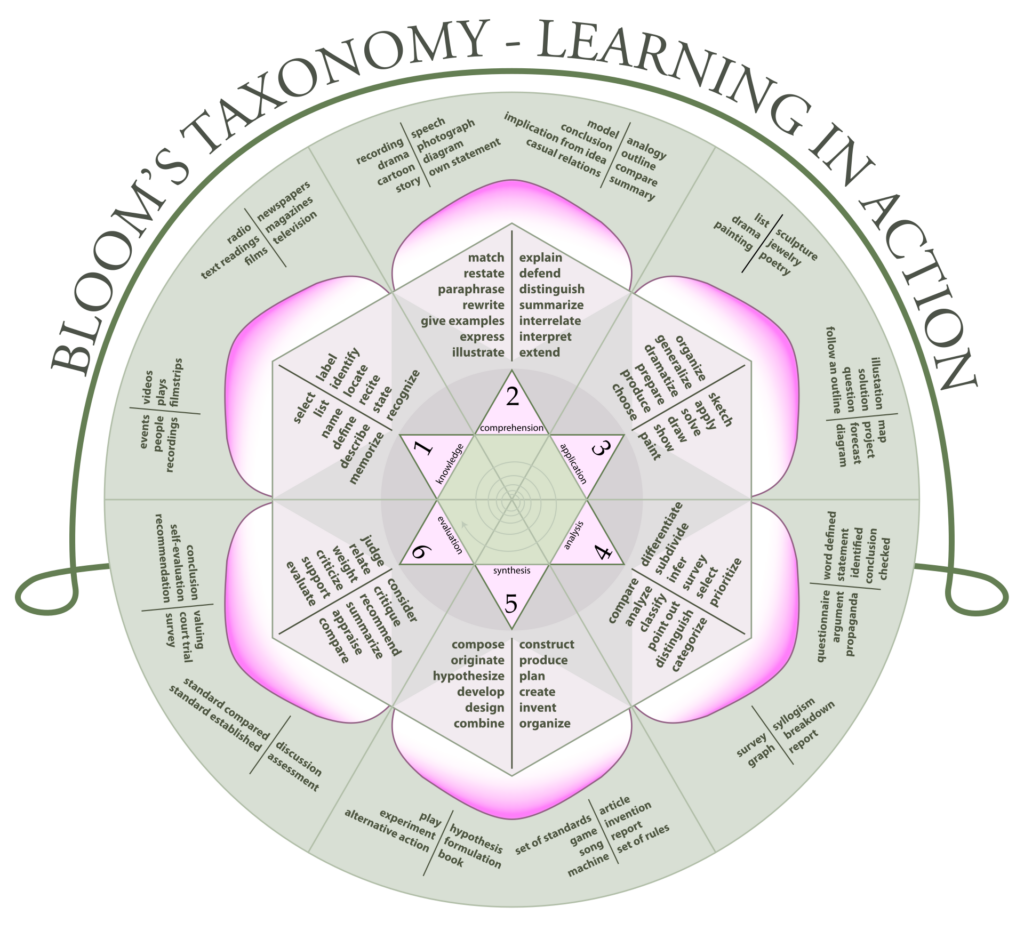
Sound familiar? You’re in great company — research consistently shows that the majority of classroom questions teachers ask sit at the bottom of Bloom’s taxonomy: recall and comprehension. And while there’s absolutely a place for knowledge retrieval, if that’s where the questioning stays, we’re leaving enormous learning potential on the table.


What Does the Research Say?

Benjamin Bloom’s taxonomy (1956), revised by Anderson and Krathwohl in 2001, remains one of the most practically useful frameworks in education. The revised model moves from Remembering at the base through Understanding, Applying, Analysing, Evaluating, to Creating at the apex. Higher-order questions push students into the top three levels — and this is where genuine critical thinking happens.

John Hattie’s landmark meta-analysis Visible Learning (2009) reinforced the power of teacher-student dialogue, finding that classroom discussion and questioning strategies have a significant effect on student achievement. More recently, Fisher and Frey (2014) describe “purposeful questioning” as a cornerstone of their gradual release of responsibility model — where the teacher’s role shifts from information-giver to intellectual provocateur.

“The questions we ask are the thinking we demand. Low questions = low thinking. If we want children to think critically, we need to ask critically.” — Adapted from Bloom et al.

The HOTS/LOTS Shortcut

A quick mental shorthand that works brilliantly in the classroom: LOTS (Lower Order Thinking Skills) vs HOTS (Higher Order Thinking Skills). LOTS questions have predictable, often single-word answers. HOTS questions require students to think, justify, compare, or create. Here’s the key difference in practice:

🔁 Flip Your Questions: LOTS → HOTS

  • LOTS: “What is an ecosystem?” → HOTS: “If a keystone species disappeared from an ecosystem, what do you predict would happen — and why?”
  • LOTS: “When was Federation?” → HOTS: “Was Australian Federation inevitable? What evidence supports your view?”
  • LOTS: “What is a simile?” → HOTS: “How does the author’s use of simile in this passage change how you feel about the character?”
  • LOTS: “What are the states of matter?” → HOTS: “Design an experiment that would demonstrate all three states of matter to a Year 3 class.”

3 Practical Strategies to Try This Week

1. The Parking Lot Question. Write a big, juicy HOTS question on the board at the start of the lesson — even before you’ve taught the content. Tell the students this is where you’re heading. It primes their brains, creates cognitive dissonance, and builds anticipation. Revisit it at the end.

2. Question Stems on a Lanyard Card. Create a small reference card of question stems aligned to each level of Bloom’s. Laminate it and keep it with you. When you feel yourself defaulting to LOTS questions, glance at the card. Stems like “How would you justify…”, “What is the relationship between…”, “How could you redesign…” are gold.

3. Wait Time. This is perhaps the single most powerful — and most underused — questioning technique. After asking a HOTS question, wait at least 5–7 seconds before accepting responses. Research by Mary Budd Rowe (1986) showed that extending wait time increased the length and quality of student responses dramatically. Silence is not failure — it’s thinking.

https://commons.wikimedia.org/wiki/File:Blooms_rose.svg


A Note for Australian Teachers

The Australian Curriculum’s General Capabilities — particularly Critical and Creative Thinking — explicitly require students to pose questions, consider alternatives, and evaluate evidence. Embedding HOTS questioning into your daily practice isn’t an add-on; it’s directly aligned with what ACARA expects. It also prepares students for NAPLAN reading and writing tasks that increasingly demand inferential and analytical thinking rather than simple recall.

💬 Your Turn! What’s your favourite HOTS question stem? Drop it in the comments below — let’s build a shared bank of great questions for Australian classrooms!

References

Anderson, L. W., & Krathwohl, D. R. (Eds.). (2001). A taxonomy for learning, teaching, and assessing: A revision of Bloom’s educational objectives. Addison Wesley Longman.

Australian Curriculum, Assessment and Reporting Authority (ACARA). (2023). Australian Curriculum v9.0: Critical and creative thinking. https://v9.australiancurriculum.edu.au

Bloom, B. S., Engelhart, M. D., Furst, E. J., Hill, W. H., & Krathwohl, D. R. (1956). Taxonomy of educational objectives: The classification of educational goals. Handbook I: Cognitive domain. David McKay.

Fisher, D., & Frey, N. (2014). Better learning through structured teaching: A framework for the gradual release of responsibility (2nd ed.). ASCD.

Hattie, J. (2009). Visible learning: A synthesis of over 800 meta-analyses relating to achievement. Routledge.

Rowe, M. B. (1986). Wait time: Slowing down may be a way of speeding up. Journal of Teacher Education, 37(1), 43–50. https://doi.org/10.1177/002248718603700110

A performance of worth

Have you heard of “death by PowerPoint”? I am sure many of us have sat through a professional development session (or maybe a few) where the lecturer (sage on the stage) thought the most efficient way to promulgate their wealth of knowledge was via a PowerPoint presentation. They probably had way too much text on the screen and read most of the text from the screen. PowerPoint was never designed to be used like this. “Less is more” is certainly true when it comes to PowerPoint presentations. PowerPoint was designed to be a visual clue for the presenter to keep on task and also to provide a scaffold for the learner via minimal text on the screen. If in doubt, have a look at most of the presenters at TED Talks.

How many of us are guilty of inflicting “death by PowerPoint” on our students? At the end of the unit of work on multiculturalism, for example, how many of us have asked for the obligatory PowerPoint presentation for the student to demonstrate their knowledge? Don’t get me wrong, an end of the unit presentation is sometimes the best way to demonstrate knowledge … sometimes! In contemporary schools, there are a plethora of ways children can demonstrate their learning, especially using technology. However, that is the scope for another blog one day!

At the end of a unit of work, apart from all the formative assessment learning activities the students have been involved in, there may be a justifiable reason for a summative assessment such as a culminating activity. No, I am not going to suggest a PowerPoint presentation here! A summative assessment, as the name implies, is an “at end of work” or “summary” of their learning. It could be as simple as the “Learn” column on a KWL chart, or as comprehensive as a website the student has created or a performance through the Arts.

Closely aligned with my previous blogs on the “so what of learning” and a “call to action”, I propose we should consider a “performance of worth”. When designing the unit of work sometimes teachers work backwards and plan from the performance of work (summative assessment activity) through all the learning activities required back to the initial learning activity to pique interest and assess prior knowledge.

If you decide a summative assessment is warranted then let us consider what might be a performance of worth. The performance of worth is a double-edged sword. It has “worth” because it is, generally, an important assessment piece to gauge student learning. Secondly, it is of “worth” to the student as they demonstrate their learning. For example, if you have been studying basic electrical circuits in Science, you could give the children a worksheet where they have to identify circuits that would work or not work. Even better, you could ask them to use an app such as Explain Everything and explain why some circuits would not work and how to make them work. Even better and more engaging would be for the student to make a house with lights and alarms that are activated by pressure pads (aluminium strips to connect the circuit). The students would not only demonstrate their knowledge, but also the application of the knowledge which s a higher-order skill (Bloom’s taxonomy). See for example https://www.instructables.com/Electronic-Cardboard-House/

Again, I have nothing against PowerPoint, is used correctly, however, there are far more engaging and higher-order performances students can utilise to demonstrate their learning.

Welcome!

Hi and welcome to TeacherTalk.site. As an experienced primary teacher with over 30 years experience and recently as an online University tutor, there is lots to talk about in the field of education!

Welcome to TeacherTalk — quote graphic on what education is

Why I Started TeacherTalk

I completed my Masters Thesis several years ago now on the need to support beginning teachers as many new teachers do not survive the first 5 years. As a result, you will see a few posts to support new teachers.

I am also passionate about the use of ICT in contemporary learning environments, so you will also find posts on the use of ICT and STEAM learning activities.

Another of my ventures was into the world of QR Codes and how they can be used in education and society, so you will find plenty of information on how to use QR Codes also.

But really, the blog is for all teachers to hopefully find a gem to make their life easier or to make the children’s learning more authentic and engaging, so they learn more and you enjoy your teaching more!

Please contact me via email matt@teachertalk.site if you would like to ask a question or commence a conversation around an event or topic.