Formative Assessment

Formative assessment refers to a wide variety of methods that teachers use to conduct in-process evaluations of student comprehension, learning needs, and academic progress during a lesson, unit, or course.

https://www.edglossary.org/formative-assessment/

Formative assessment is the ongoing day to day check of student learning. It can be a simple thumbs up or thumbs down to check understanding or can be more complex and time consuming such as a Kahoot Quiz to check comprehension of the content. It is a checking of the pulse to check on student learning – to see what is understood and what needs to be learned or retaught. Often teachers use formative assessment to see how their teaching is going – did the children understand this concept/process or do I have to reteach it in another way?

Good formative assessment strategies don’t need to be complicated. A well-chosen strategy — quick, low-stakes, and easy to act on — tells you exactly where students are up to before you plan the next lesson.

Formative Assessment Strategies to Try

However, before we get too carried away, it is important to understand some of the formative assessment strategies you can use to assess student learning. The following list is not exhaustive:

  • questioning
  • work samples
  • interview
  • observation
  • self assessment
  • peer assessment
  • journals
  • etc.
Students using a laptop as part of a formative assessment strategy

Once you have decided upon the purpose and the type of formative assessment you will conduct, it is important to also decode HOW you will keep and store this data. This is known as a record keeping device. For instance, if you choose to observe how each child is working collaboratively on a small group task, how is it best to record this information? You could use a checklist which has differing levels of agreed statements of what collaboration looks like in a small group. Sure, you could video each child at work and store the video in their portfolio, but you will still have to watch the video at some stage to make an on-balance judgement about the child’s capacity to work collaboratively. Alternatively, you could make the agreed statements on what collaboration looks like with the children and ask the children to complete both self and peer assessments of their collaboration.

Fortunately, many of the time consuming “old-days” formative assessment tasks are being made easier through the use of technology. Apps and software such as Kahoot, Plickers to check understanding and others which allow the student to illustrate their understanding such as Explain Everything, Google Forms or even a Padlet. Through careful planning in the initial stages, the astute teacher will have highlighted in their term planner the learning activities that will be used as a formative assessment so the task does not become onerous and really is an authentic assessment of student learning.

Assessment

In education, the term assessment refers to the wide variety of methods or tools that educators use to evaluate, measure, and document the academic readiness, learning progress, skill acquisition, or educational needs of students.

https://www.edglossary.org/assessment/

Assessment is a word that can drive fear into both students and teachers alike! The word “assessment” originally comes from the Latin words “ad” meaning to or at and “sedere” meaning sit, so the word means “to sit beside”.

In practice, this breaks down into three purposes — assessment for, as and of learning — each playing a different role in the classroom, from day-to-day check-ins to formal reporting.

Assessment is about the gathering of data to make judgements about student learning. The data can come from the students, teachers or from standardised tests. The purpose of assessment is to primarily gauge student learning. When planning a unit of work, teachers must be cognisant of the ongoing need to assess student learning and to revise their teaching plan accordingly. One of the first tasks in successful planning t is to know your stuents, so the first assessment task might be to assess prior knowledge to gauge “where the children are at” so the planning can be specific and targeted to the children’s needs.

Assessment for, as and of learning — the three purposes of assessment

The Three Types: Assessment For, As and Of Learning

Basically, there are three purposes of assessment — assessment for, as and of learning:

  • assessment for learning;
  • assessment as learning and
  • assessment of learning.

Assessment for learning involves the teacher making inferences about student progress to inform their teaching. The emphasis here is using mini assessment tasks to inform the teaching and to assist the student to learn more. It is about improving teaching and learning, rather than achieving a mark or a score. It can provide feedback to encourage the student to move forward and to improve.

Assessment as learning involves students reflect on their own learning to inform their learning goals. Assessment as learning encourages students to take responsibility for their learning and to be reflective. It requires students to ask questions about their learning, to refcelt and to modify their learning gaols in order to succeed.

Assessment of learning involves teachers using the evidence of student learning to make judgements about student progress towards the standards/outcomes/objectives/content descriptors as mandated by the educational authority.

The two types of assessment are formative assessment and summative assessment. As their names imply, formative assessment is ongoing assessment during the learning process and summative assessment usually occurs at specific periods, especially at the conclusion of a unit of work. Whereas formative assessment is primarily for the student and teacher, summative assessments are usually for external stakeholders, such as parents at report time or for government and educational jurisdictions.

Planning

Lesson and unit planning for teachers is one of the most arduous tasks in the job — deciding what and how to teach on a term, month or weekly basis. It doesn’t just happen; it takes many hours of careful preparation to know:

  • the diverse needs of your students
  • curriculum content
  • pedagogical approaches
  • school-based curriculum maps and policies and
  • classroom management.

Teaching can never be replaced with robots as it is the integral knowledge and application of the above factors that lead to the craft of teaching.

If you do not spend adequate time planning, the students learning will be lessened and you are likely to have more classroom management issues. Well planned lessons that actively engage the students will enhance their learning and keep them on task.

Lesson and unit planning for teachers — fail to plan, plan to fail

Lesson and Unit Planning for Teachers: Where to Start

Planning is the first step in the teaching-learning cycle and begins with preparation. A thorough knowledge of the curriculum content is essential as these are the mandated outcomes/objectives/content descriptors you MUST teach and assess. Not only do you need to know the content for your year level (as a primary generalist teacher), but you also need to know the content the year preceding and following to allow for differentiation.

The teaching-learning cycle — where lesson and unit planning for teachers begins

Due to an overcrowded curriculum, some teachers try to integrate the curriculum content through the use of big concepts, themes or integrated units of work. You do not have to reinvent the wheel as there are many great units of work available on the internet to be modified for your own class. In addition, teachers can program together with similar year level/subject teachers or in teams.

The time spent in planning, especially in your first few years of teaching, will be rewarded. As a new teacher, run through each lesson for the next day in your head. Try to visualise how each part of the lesson will run. Have all the materials ready for the lesson and think about the movement of students issues to alleviate any possible disruptions.

A Weekly Planning Rhythm for Teachers

Term and unit plans set the direction. The weekly plan is where the term actually happens. A simple rhythm keeps lesson and unit planning manageable, even in a busy term.

Thursday or Friday: sketch next week. Check where each subject sits in its unit. Note any whole-school events, then block out assessment tasks first. Everything else fits around them.

Each afternoon: finish tomorrow in detail. Gather your materials and adjust the plan from what you saw today. A quick look at your exit tickets tells you who needs another go before you move on. These formative assessment checks are the bridge between today’s lesson and tomorrow’s plan.

Every fortnight: look up. Compare the unit plan with what you have actually taught. Trim what will not fit now, rather than rushing the last two weeks of term.

What Every Lesson Plan Needs

A lesson plan does not need to run for pages. In your first years, though, writing these parts down trains the habit:

  • a learning intention in student-friendly words
  • success criteria students can check their work against
  • a short review or hook to open the lesson
  • the teaching sequence, from modelling to guided practice to independent work
  • a check for understanding before students leave
  • materials, groupings and transitions
  • adjustments for students who need them.

Experienced teachers carry much of this in their heads. That only happens after years of writing it down first.

Going Deeper With Planning

This post covers the everyday basics. For the bigger picture, start with planning backwards from the outcome you want. From there, you can learn to plan for every learner with UDL and spot the signs it is time to fade the scaffold. Together they turn a good weekly plan into a well-designed unit.

How to create an audio QR Code

An audio QR code could be made to provide instructions to a student in an independent learning activity or for a student with a lower reading ability, thus freeing up the teacher . An audio QR code could be used to link to a read-aloud story for a child to enjoy. An audio QR code could be a child describing their artwork, their goals for the year, an example of their reading proficiency, or for whatever purpose you wish to record an audio file! An audio QR code for classroom use takes just minutes to set up and gives students an instant, hands-free way to hear it.

Making an Audio QR Code for Classroom Use

The process is quite straighforward – record an audio file, store it and then create a QR code linking to that audio file.

An audio QR code for classroom use, paired with a character image
This QR code has both the character (image) and their speech (audio file).

There are many ways to record an audio file and as many ways to store the file (Dropbox, Google Drive, etc.) I think the fewer steps involved the better for already busy teachers! Although a little pricey ($7.99 AUD), I recommend the Cloud QR Generator from the App Store as it provides the most options for creating a QR code and is super easy to generate and store the QR Code (either to their cloud server or your own Google Drive.)

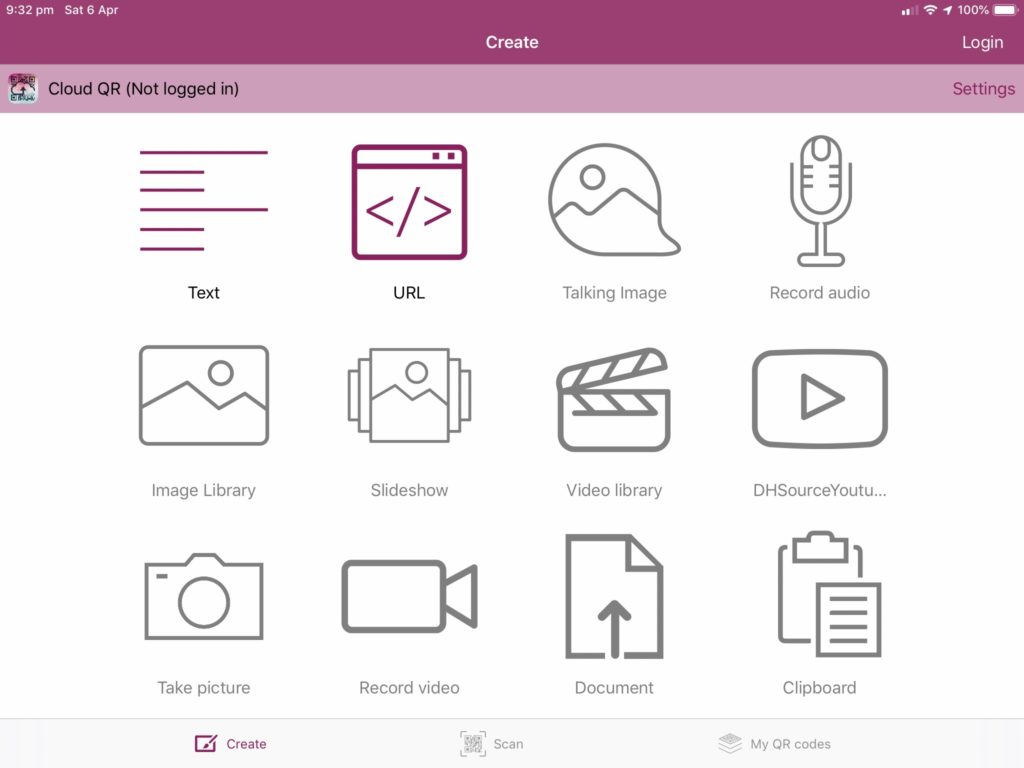
The options in Cloud QR Generator

You will need to login to your account. However, if the teacher were to login to just one device, each child could use the app in turn to create their QR code and then save to a Google Drive, etc.

In order to create an audio QR code, simply click on the “Record audio” icon. You will need to give permission for the software to use the microphone. You are able to record up to 5 minutes and when ready, simply press the microphone icon to start recording. There is no countdown and recording begins straight away. Press the pause icon to stop the recording.

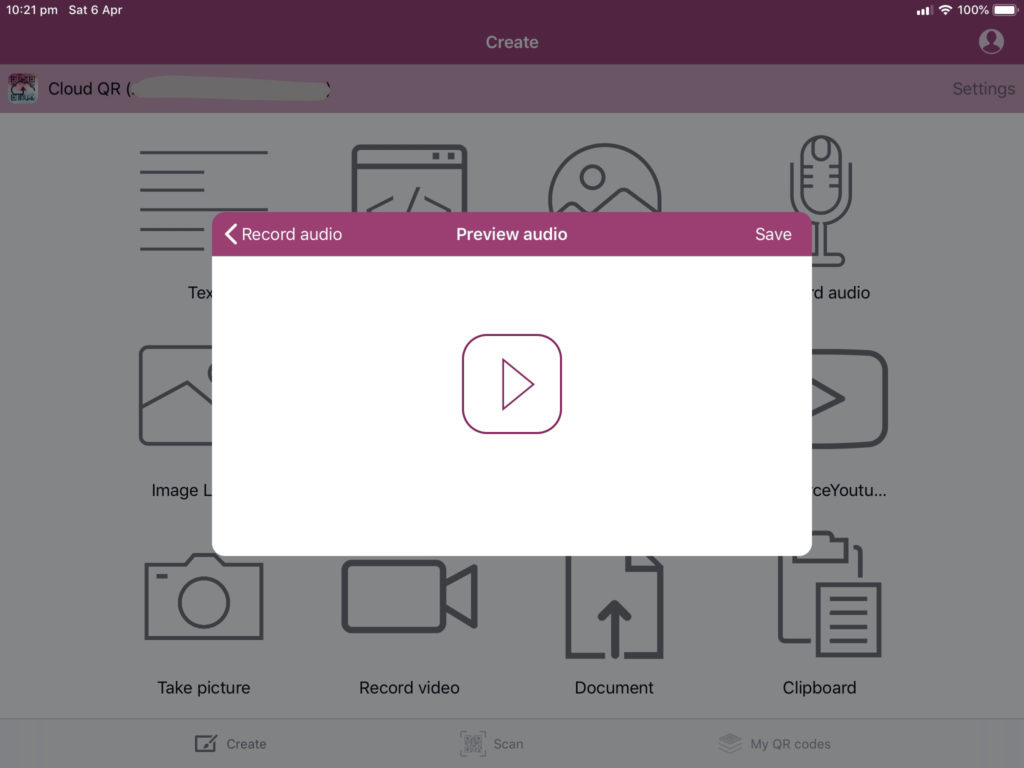
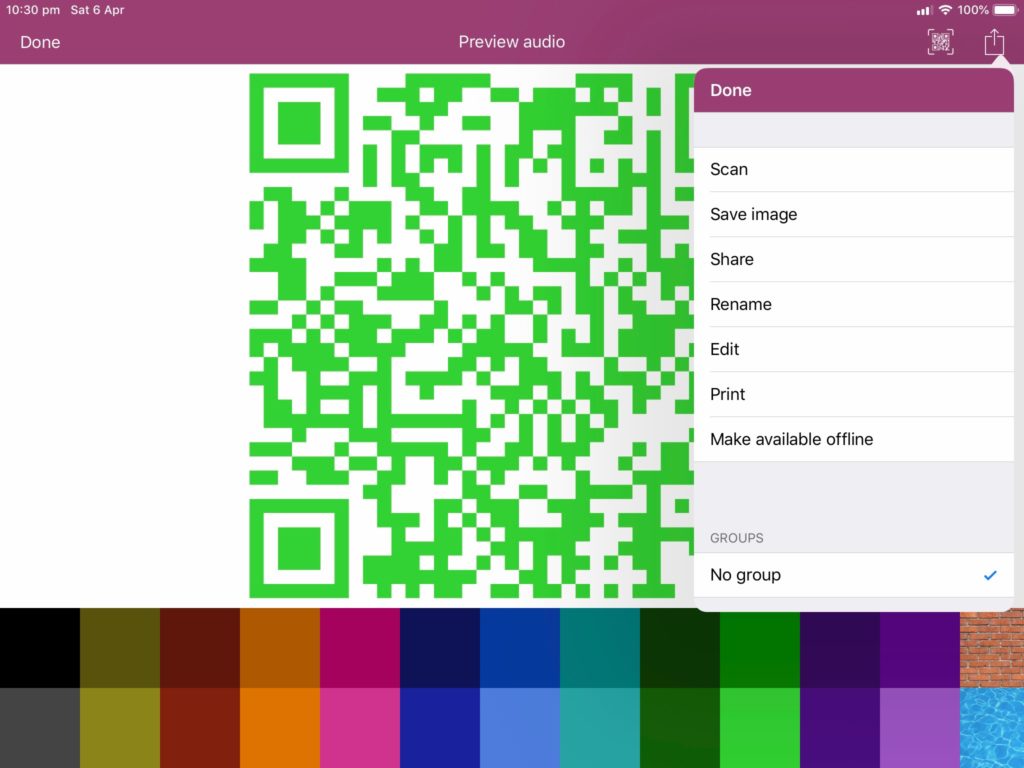
When the recording is finished, you can preview by pressing the play icon, or you can save the audio file. Pressing save will bring up the QR code for display where you can change colours or use the Share icon to rename (a very good idea to a name that is meaningful) and then to save the image (QR Code). When you press “save image” you will be asked for access to your Photos. The QR code image will be saved to your Photos on your mobile device where you can print or use later in your teaching.

Here is a great video showing how to do most of the above!

What are some the creative ways you could use an audio QR code in your classroom?

  1. Thanks Matt, I will check out the Pintrest. I think it would be very beneficial to have a more practical…

  2. Thank you for these posts Matt. Keep them coming. I am graduating in about a year and very nervous. Does…

QR Codes

What are QR Codes? QR stands for Quick Response code, as scanning the 2D “code” will provide a response to:

a website; a voice message, a video, a text message (anything alphanumeric), a Google map, wifi login, slidehows, YouTube clips, etc. So they are VERY handy items to make and have in your teaching arsenal! QR codes for the classroom are a simple, low-cost way to hand students a link, a file or a message without typing out a long URL.

Scanning and Making QR Codes for the Classroom

So, how do you scan a QR Code? Look on either Google Play or the App Store. I suggest i-nigma as it is free and has a high scan rate.

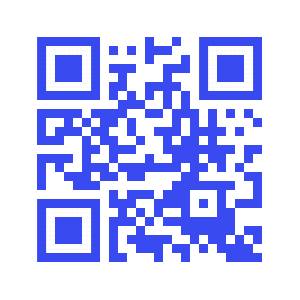
Example of a QR code for the classroom linking to the TeacherTalk website

For example, if you scan the blue QR code above, it contains the URL to this website. Teachers can, therefore, easily prepare QR codes to enable students (especially younger students) to access specific websites, even if they have elongated URLs.

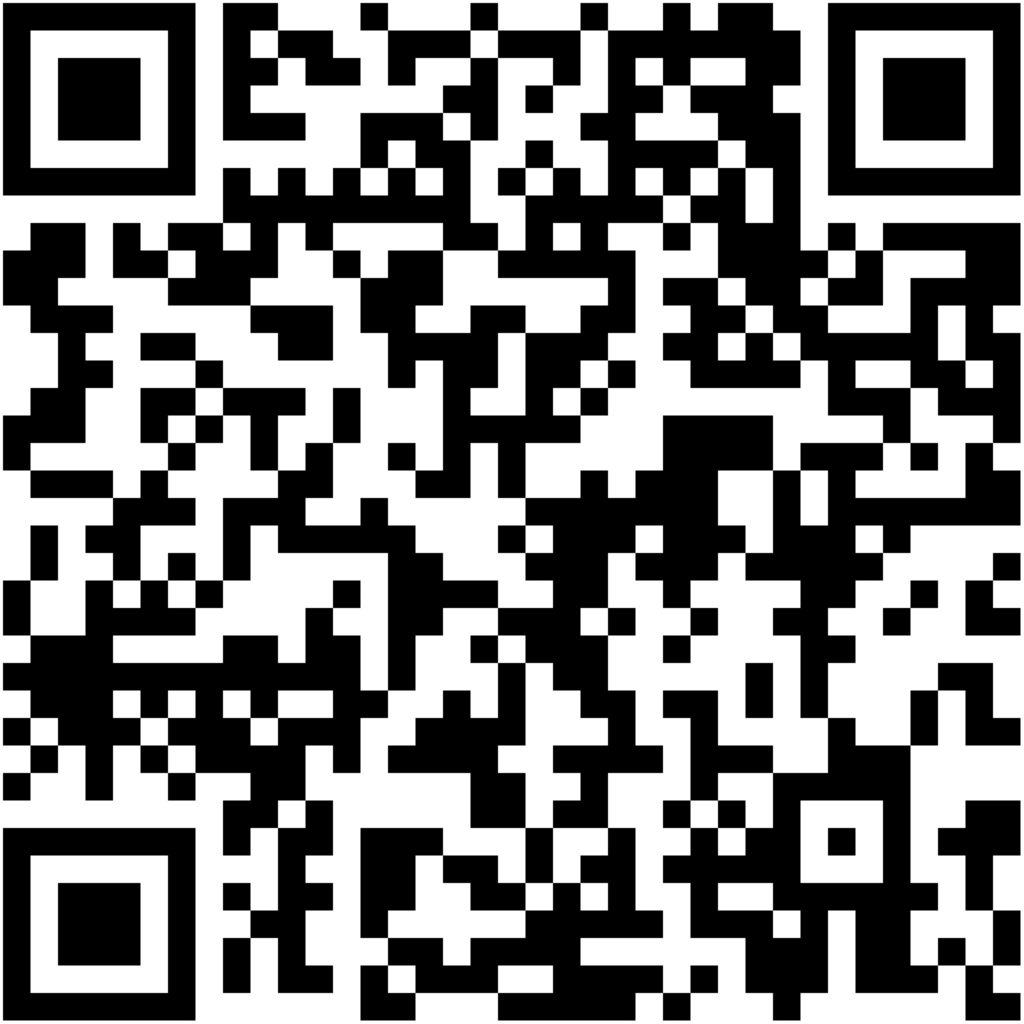
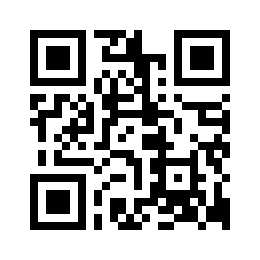
An audio QR code for the classroom linked to an audio file
This QR Code links to an audio file.

So, how do you make a QR Code? There are plenty of QR Code generators on the internet which are free to use for a basic downloadable QR Code to be used in the classroom. (See QR Code Generator or QRStuff). Some companies provide a paid version where you can change the colours, insert your own logo, etc.

You can find out more about how to use QR Codes on my Pinterest page.

Please read the subsequent post on how to create an audio QR Code.

Welcome!

Hi and welcome to TeacherTalk.site. As an experienced primary teacher with over 30 years experience and recently as an online University tutor, there is lots to talk about in the field of education!

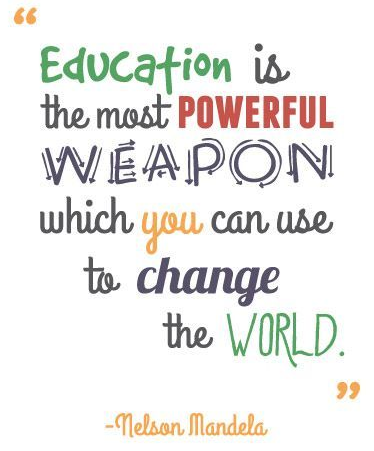
Welcome to TeacherTalk — quote graphic on what education is

Why I Started TeacherTalk

I completed my Masters Thesis several years ago now on the need to support beginning teachers as many new teachers do not survive the first 5 years. As a result, you will see a few posts to support new teachers.

I am also passionate about the use of ICT in contemporary learning environments, so you will also find posts on the use of ICT and STEAM learning activities.

Another of my ventures was into the world of QR Codes and how they can be used in education and society, so you will find plenty of information on how to use QR Codes also.

But really, the blog is for all teachers to hopefully find a gem to make their life easier or to make the children’s learning more authentic and engaging, so they learn more and you enjoy your teaching more!

Please contact me via email matt@teachertalk.site if you would like to ask a question or commence a conversation around an event or topic.